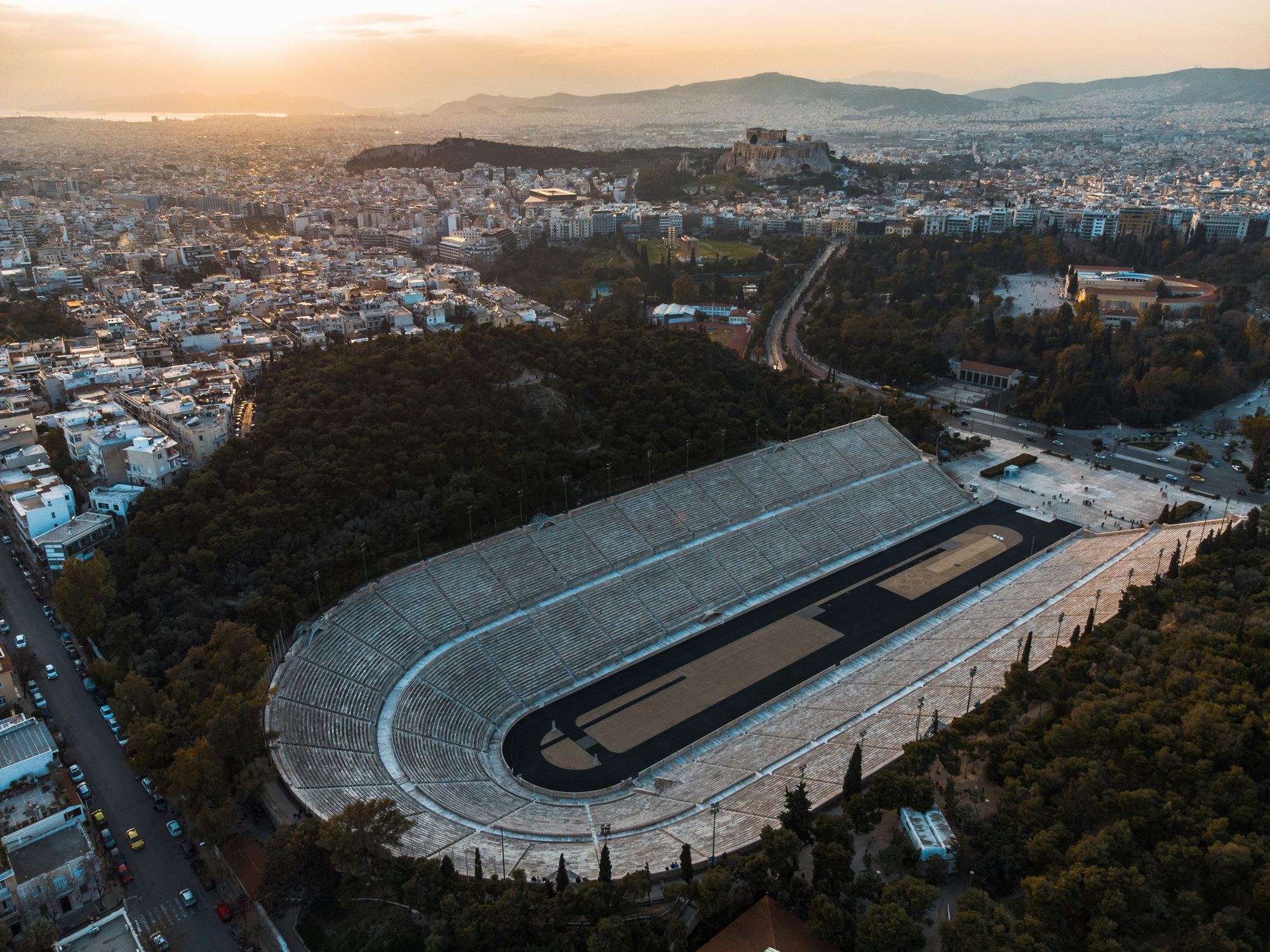
The Panathenaic Stadium, Athens, where the 2004 Olympic marathon finished. Photo: Fotis Fotopoulos on Unsplash
Who hits the wall?
Late in a marathon, thousands of runners slow to a walk. Across 1.4 million finishers, more of them were men than women, even among runners who finished in the same time. Your legs explain some of that. A habit of mind may explain the rest.
Athens, 22 August 2004. Paula Radcliffe held the marathon world record and had won London twice. She was the favourite. The race set off at six in the evening in heat of more than 30°C, on the old route from the town of Marathon into Athens.
Late in the race, Kenya’s Catherine Ndereba went past. At 36 km she stopped. She looked back down the road, tried to run again, managed a few strides, and stopped for good. Millions watched her cry at the roadside.
What the cameras couldn’t show were the weeks before. A knee injury had been treated with cortisone and anti-inflammatories, and she had slept badly that night. In the race she felt “very, very cold” in the heat. The hardest part, she said later, was realising she couldn’t hold a straight line.
She has described stopping as self-preservation: the only way to finish was to push her body to complete collapse. Eleven weeks later she won the New York Marathon.

Photo: Martin Sanchez on Unsplash
The wall
Runners have a name for the moment the body gives out late in a marathon: hitting the wall. Radcliffe’s evening had more causes than most.
For ordinary runners the wall tends to come at about mile 20. On the Boston course it comes at the worst possible place: the Newton hills, ending at Heartbreak Hill.
Boston, 21 April 2014
It was the first Boston Marathon after the 2013 bombing, and the city turned out in huge numbers. Meb Keflezighi became the first American man to win since 1983. But this story is about the other 31,983 finishers: the ones still on the course hours later, and what happened to them at around the 20-mile mark.
Every runner carried a timing chip, so every runner left a trail of 5 km splits. The replay below turns those splits back into a race. Each dot is one runner, placed by how much slower they are running than their own pace from 5 to 20 km. Press play and watch what happens after 30 km.
Now pick the runners who finished in 3:30 to 4:00, so that speed can’t explain the difference. By 40 km, 37% of the men in that group are in the wall, against 10% of the women.
Tower Bridge during the London Marathon. Photo: JP Sheard on Unsplash
Not just Boston
One race on one hilly course could be a fluke. So we looked at 1.43 million finishers in 42 more marathons: Berlin from 1999 to 2019, Chicago from 2000 to 2018 and London from 2014 to 2018, leaving out three years with no usable half-way times.
Here, hitting the wall means running the second half at least 20% slower than the first.
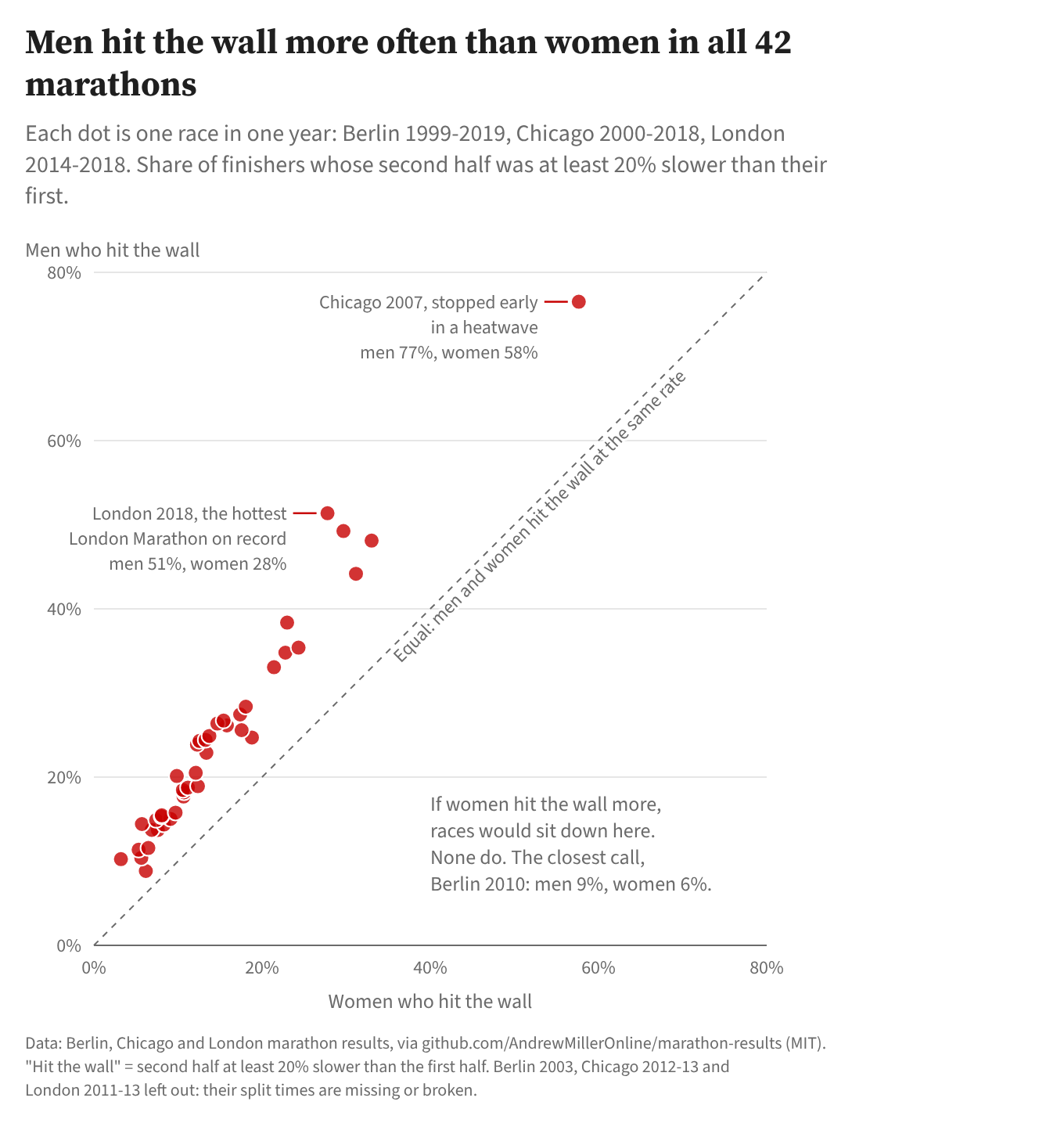
In every one of the 42 races, more men hit the wall than women. The closest call was Berlin in 2010, with 9% of men and 6% of women.
Heat makes it worse for everyone. In 2007 Chicago was stopped early in a heatwave, and 77% of the men who finished hit the wall, against 58% of the women. London 2018 was the hottest London Marathon on record: 51% of men hit the wall, and 28% of women. Athens in 2004 was hotter than either.
Same ability, different crash
Men are faster on average, and slower runners fade more, so a fair test compares runners who finish in the same time.
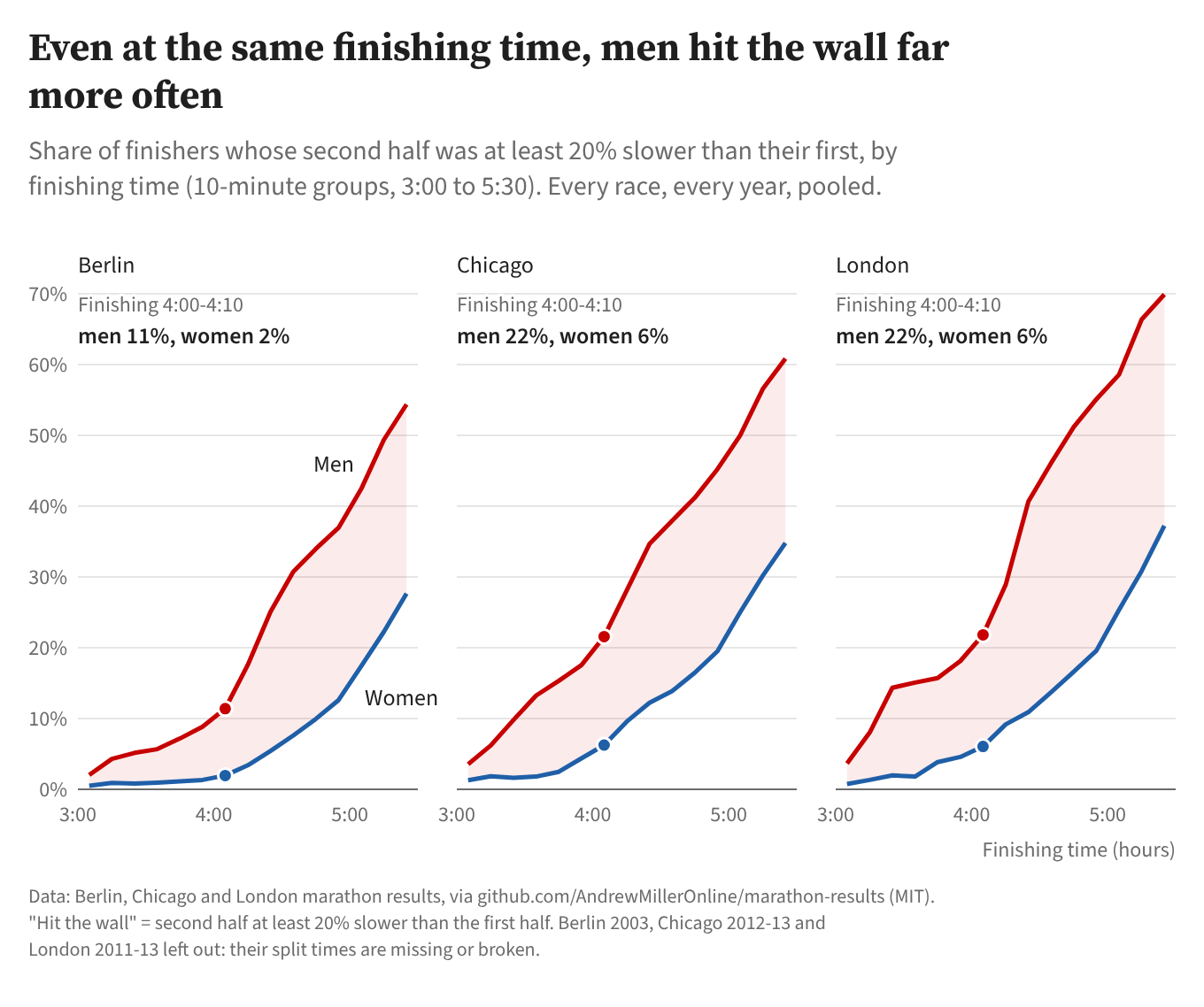
At every finishing time from 3:00 to 5:30, in all three cities, the men’s line sits above the women’s. Among runners who finished in 4:00 to 4:10, 22% of men hit the wall in Chicago and London, against 6% of women. In Berlin it was 11% against 2%.
The middle of the pack
Take the 648,000 runners who finished between 3:30 and 4:30. Most of them, men and women alike, slowed a little in the second half. That is normal. The difference is in the tail.
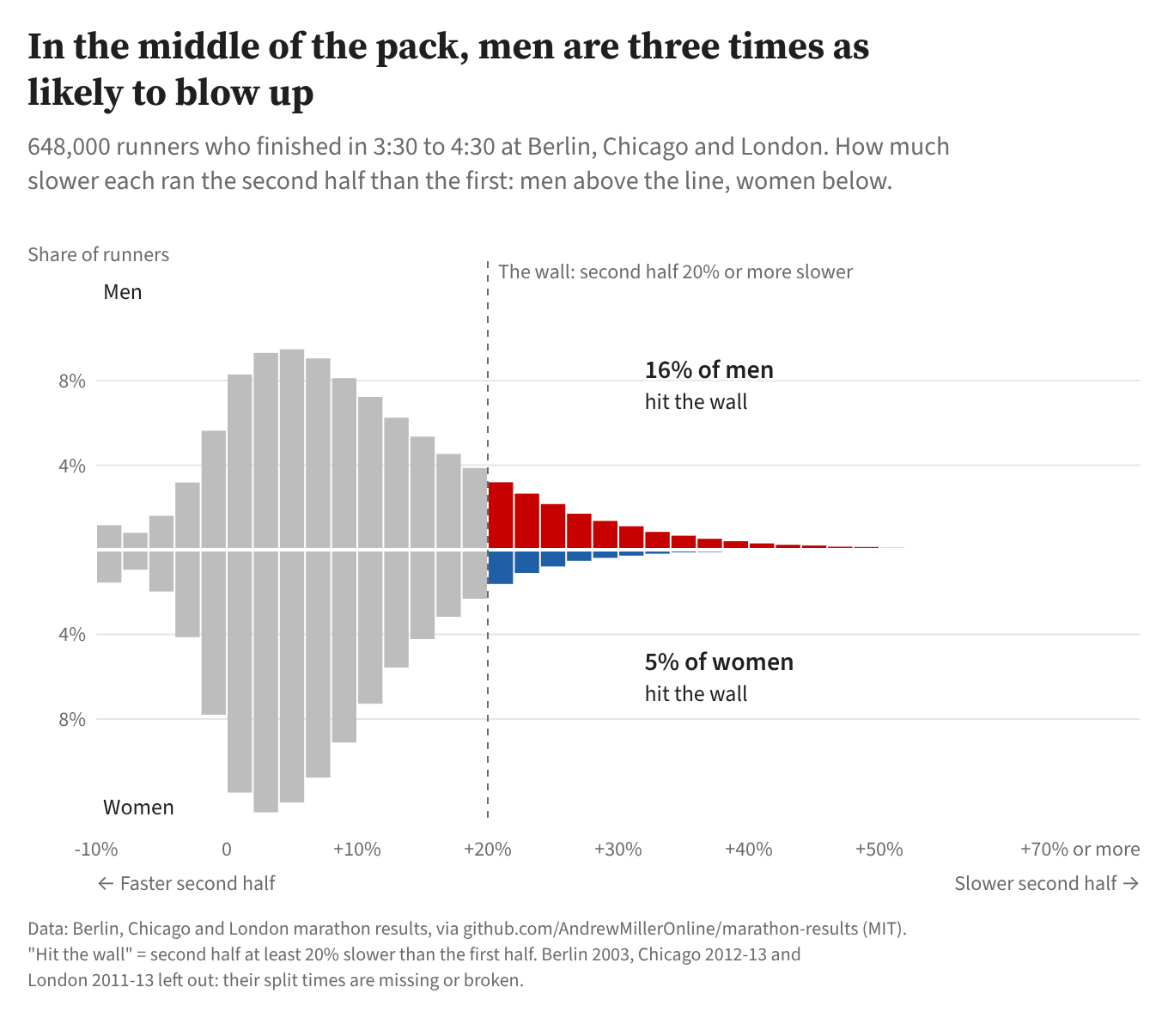
16% of the men ran the second half at least 20% slower, against 5% of the women. In the middle of the pack, men were three times as likely to blow up.
Photo: Ben Stern on Unsplash
Off too fast
There is a physical part. Muscles run low on stored fuel (glycogen) late in a marathon, and women tend to burn more fat along the way. But physiology doesn’t decide how fast you set off.
You do.
Pacing is a decision made under uncertainty. In a study of 92,000 runners in 14 American marathons, men were about three times as likely as women to slow by 30% or more, and the researchers’ best explanation was riskier decisions about early pace. At the 2013 Houston Marathon, men overestimated their abilities more than women did, and slowed down more in the later stages of the race.
The wall is often the bill for the first half.
Nature or nurture?
Psychologists argue about where that confidence comes from. A biological account points to testosterone and risk-taking. A social learning account points to what boys see rewarded: going for it, never backing off. That is the same Bandura who appeared in Story 01.
Even in the middle of the pack, 84% of men did not hit the wall. Psychologists call it alpha bias when a real but small difference gets turned into a rule about everyone. The charts show a tendency, not a destiny.
And the most famous wall of all belongs to a woman. Radcliffe’s was not about pacing. It came from heat and injury, and from a body that she has said was close to collapse. It didn’t define her career either. She won New York that November, then London again and the world title in 2005.
The advice that follows from the data is not new, but the numbers make it hard to ignore. Run the first half as if the wall is waiting, because for about one man in six, it is.
For your exam
This story touches gender (biological and social explanations) and research methods: operationalising a behaviour, natural comparisons between groups, and the chi-squared test.
Aim
Deaner and colleagues (2015) asked whether men are more likely than women to slow down in the second half of a marathon.
Method
Secondary data: about 92,000 finishing times from 14 American marathons in 2011. Each runner’s second-half pace was compared with their first-half pace.
Findings
Men slowed by 15.6% on average and women by 11.7%. Men were about three times as likely to slow by 30% or more. The difference appeared in all 14 races.
Operationalisation
“Hitting the wall” has to be defined before it can be counted. This story uses two definitions: 25% slower than your own pace from 5 to 20 km, and a second half 20% slower than the first. The gap appears under both.
Evaluation points
- Strength: huge samples of real behaviour, recorded objectively by timing chips.
- Weakness: sex can’t be assigned at random, so this is not a true experiment and can’t prove cause.
- Weakness: race results show what runners did, not why. Confidence was not measured directly.
- Debate: biological and social explanations both fit the data.
Avoiding alpha bias
A real difference between groups can still be small. In the middle of the pack, 84% of men did not hit the wall.
Exam-style question · 4 marks
Researchers defined hitting the wall as running the second half of a marathon at least 20% slower than the first. Explain one strength and one weakness of operationalising it this way.
Sources
- The 2004 Olympic women’s marathon, Wikipedia
- Paula Radcliffe on Athens 2004, Sky Sports
- Keflezighi wins Boston, CBS News
- Boston Marathon history, Boston Athletic Association
- Deaner, Carter, Joyner and Hunter on men slowing in the marathon
- Hubble and Zhao (2016), Journal of Sports Analytics
- Race data: Boston 2014 results; Berlin, Chicago and London results (MIT)
Photos
- Panathenaic Stadium: Fotis Fotopoulos on Unsplash
- Runner on the track: Martin Sanchez on Unsplash
- Tower Bridge: JP Sheard on Unsplash
- Elite pack: Ben Stern on Unsplash
- Charts and race replay made for The Replay Lab